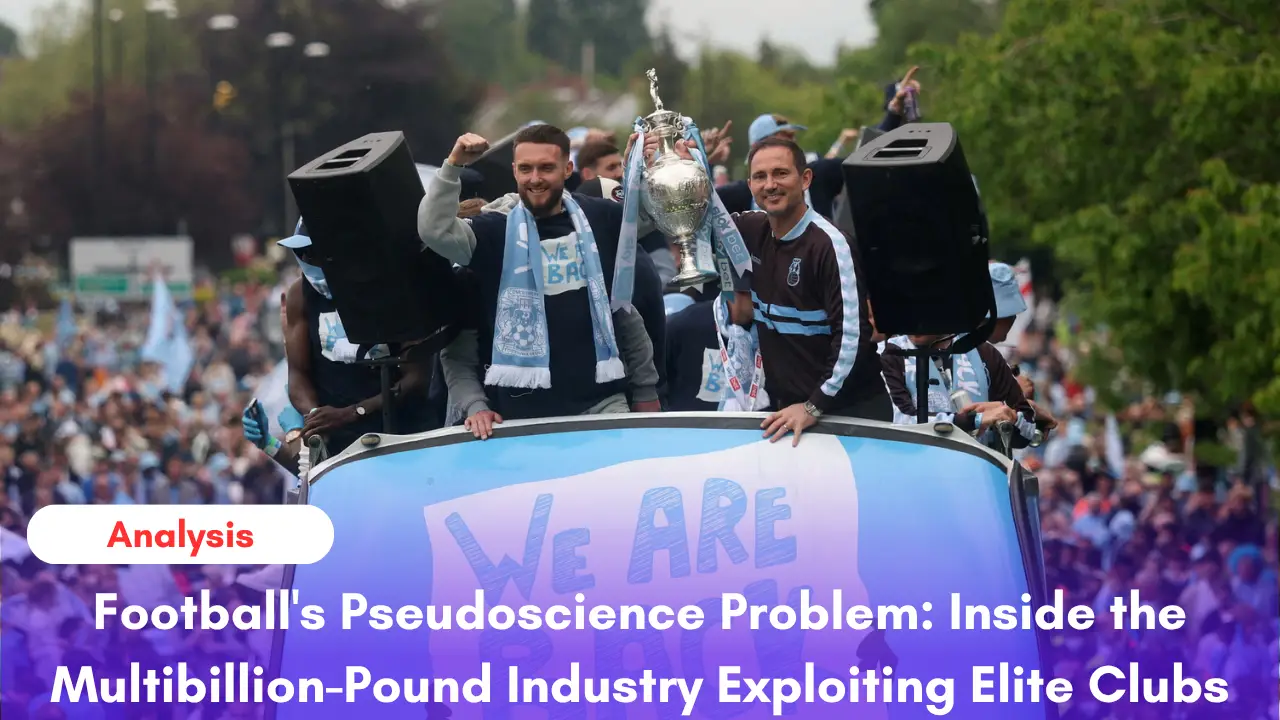
Dr Claire-Marie Roberts still remembers the phone call. A salesman wanted to know if she was aware that the atmosphere is only 21% oxygen — as though this were a revelation rather than GCSE-level chemistry. His pitch: bottled oxygen, ready to sell to her players at Coventry City.
Roberts, who spent nine years working within the Premier League before two seasons as Coventry’s performance director and has since joined Formula One outfit McLaren as director of human performance, turned him down. But she says the pitch was far from unusual. At the height of her time in football, she was fielding as many as 50 unsolicited messages a week from companies pushing devices, supplements and “technologies” promising transformative gains for players.
Her verdict on the state of the sport: elite football has a science problem, and it’s getting worse.
A widening gap between evidence and practice
Roberts describes what she calls a “science-practice gap” that she believes has grown throughout her career. She points to aggressive, polished marketing aimed squarely at a workforce hungry for any edge — footballers under constant pressure to outperform, recover faster and extend careers, often with substantial money to spend chasing it.
“It’s bordering on exploitation,” Roberts says of the industry targeting susceptible athletes searching for performance shortcuts.
Cryotherapy: a training-ground staple with almost no evidence behind it
Among Roberts’s central targets is cryotherapy — the whole-body cold chambers now standard at many top-level training grounds, with ice baths as the fallback where a chamber isn’t available. The trend has become so mainstream that Bayern Munich’s Harry Kane was pictured climbing into a bin of ice following a Club World Cup match last year.
Roberts says most clubs use cryotherapy without being able to explain, scientifically, why. She notes the supporting research is thin, limited largely to a narrow study suggesting a possible link to dementia prevention — not performance or recovery. More troublingly, she cites emerging evidence that cryotherapy could actually interfere with muscle adaptation rather than aid it.
Her recommendation is blunt: recovery is overwhelmingly driven by sleep and nutrition, and no amount of cold exposure compensates if those fundamentals are neglected.
Supplements: an industry built on need, not hype
The supplement industry fares no better in Roberts’s assessment. She singles out vitamin D — genuinely useful given widespread deficiency in northern-hemisphere populations from limited sunlight — and vitamin C as the rare cases with solid evidentiary backing. Beyond that, she argues supplementation should be strictly needs-based rather than habitual.
Her broader point: athletes are popping pills without understanding their purpose, when performance and recovery ultimately come down to sleep quality and adequate, quality nutrition. No supplement regime fixes a poor diet.
Trickle-down pseudoscience from the game’s biggest clubs
Roberts, who worked under Frank Lampard using an evidence-led methodology, says much of football’s susceptibility to unproven practices stems from imitation. When elite, resource-rich clubs and national federations adopt a product or method, other clubs assume it must be legitimate — a dynamic she describes as misplaced confidence in claims that were never scientifically substantiated in the first place. The result, she says, is that clubs across the pyramid copy behaviours without asking whether they’re grounded in evidence at all.
A former competitive swimmer who missed selection for the 1996 Atlanta Olympics through injury, Roberts believes football is uniquely vulnerable to this dynamic compared with other sports she’s worked in, largely because of how high the financial and competitive stakes have become.
Kinesiology tape: “a big white elephant”
Roberts reserves particular scepticism for kinesiology tape — the colourful strips worn by players including Cristiano Ronaldo, Gareth Bale and David Beckham. She says there is no credible evidence it affects injury prevention or on-pitch performance; at best, she suggests, it may offer a psychological sense of support. She distinguishes it sharply from medical strapping, which provides genuine, if modest, joint protection after injuries such as dislocations. Kinesiology tape, by contrast, she calls a straightforward placebo.
Why football won’t fix itself easily
Roberts attributes much of the problem to entrenched coaching cultures: long-serving managers who continue practices from earlier in their careers, or who adopt new products on the recommendation of colleagues without scientific training. Until clubs put rigorous evidence-based decision-making at the centre of performance departments — and employ staff equipped to properly evaluate vendor claims — she expects the problem to persist.
She describes football as fundamentally resistant to critical, scientific thinking compared with other elite sporting environments, arguing that few clubs apply the kind of scrutiny needed to separate genuine performance science from marketing.