By Daniel Cross | Football Writer, Sportspherearena
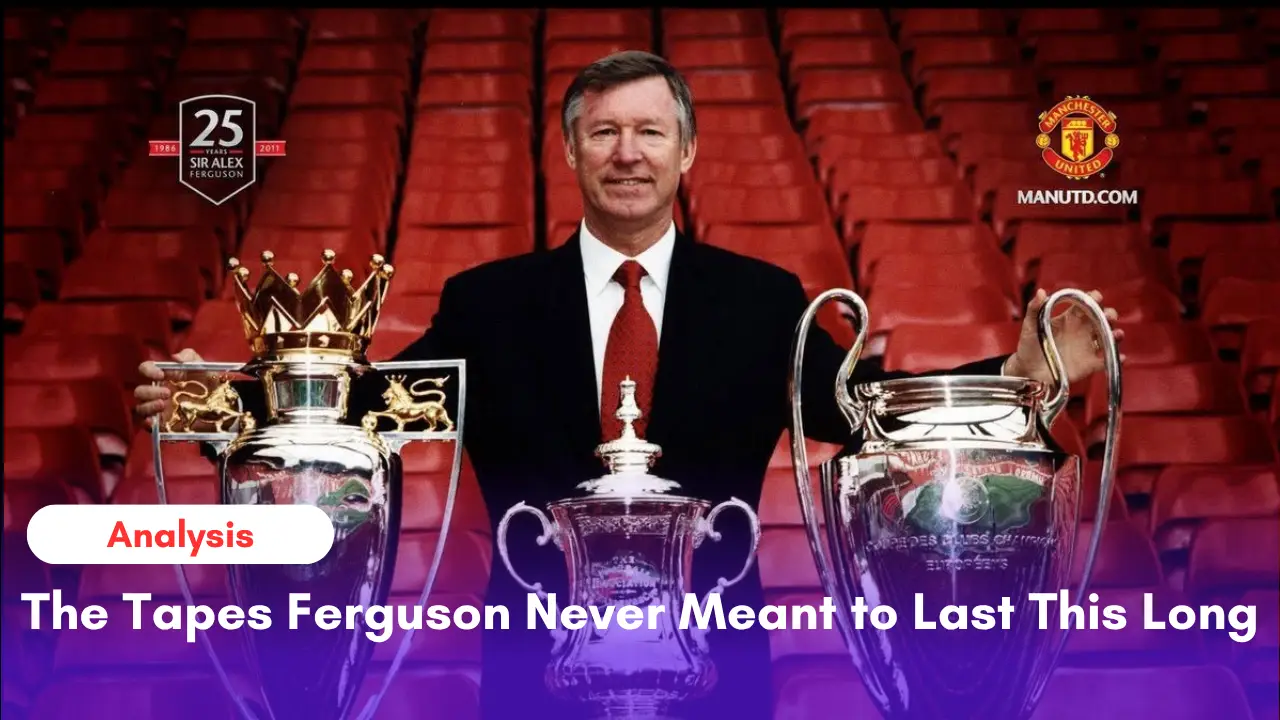
There is a version of Alex Ferguson that exists only on a stack of reel-to-reel tape, recorded by a local radio reporter who Ferguson trusted enough to actually talk to. Not the sanitised programme notes. Not the newspaper column written by someone summarising a press conference from the back of the room. The man himself, unguarded, a few days after whatever had just happened to him.
Tom Tyrrell covered Manchester United for Piccadilly Radio through Ferguson’s first years at the club, and Ferguson gave him access nobody else got. Those tapes sat untouched until Tyrrell’s grandson handed them to author Wayne Barton, who was already deep into a book on Ferguson’s early Old Trafford years. What they contain is not hindsight. It’s the raw feed — a manager mid-crisis, mid-triumph, mid-joke, with no idea how any of it would end.
It starts, fittingly, with a sacking that had nothing to do with football.
The bus driver had to go
Ferguson’s first game in charge was a 2-0 defeat at Oxford United in November 1986, and the first man to feel his presence wasn’t a player. It was Derek “Sooty” Sutton, the team bus driver, who under Ron Atkinson had sat beside the manager on the bench and poured the half-time tea. Ferguson found him there at the Manor Ground and, without a word to Sutton directly, arranged for it to stop.
Sutton never forgave him. Ferguson barely remembered the conversation. His account to Tyrrell was almost bureaucratic — he simply noticed the driver in a seat that wasn’t his to sit in, and dealt with it. The gap between how much that moment mattered to each man says most of what you need to know about the two decades that followed.
On the pitch that day, Paul McGrath came off with United already behind to a John Aldridge penalty, having gone into the game short of sleep after a Friday night out. Oxford scored again within two minutes of his withdrawal. There was no new-manager bounce — just a warning of the drinking culture Ferguson would spend years trying to dismantle.
A greeting nobody was meant to hear twice
Two weeks later, Ferguson stood in front of an Old Trafford microphone for the first time, addressing the home crowd before a game against QPR. It’s a strange piece of tape — earnest, almost formal, the words of a man who understood exactly how big the job was and hadn’t yet worked out how to sound comfortable saying so. He thanked the travelling fans from a scoreless draw at Norwich and promised to make United “the greatest club in Britain.” United won 1-0, John Sivebaek scoring the only goal. The pitch, and the results, took a lot longer to catch up with the ambition in his voice.
A prank that got away from him
By the following spring, Ferguson had enough comfort with Tyrrell to play along with an April Fools’ joke about Old Trafford switching to red, luminous turf, complete with glow-in-the-dark goalposts. Several outlets ran it straight. It’s a small moment, but a telling one — it’s the only tape in the whole archive where Ferguson sounds like he’s enjoying himself rather than fighting something.
What the job actually cost
The tapes turn heavier from there, and stay that way. A year into the job, reflecting on what United meant to him, Ferguson recalled a conversation with former Aberdeen chairman Dick Donald before he left Scotland — being told there was only one club that could satisfy the ambition eating at him. He talked about the switchboard operator who cared about the club the way he needed every member of staff to care. It’s sentimental in a way Ferguson rarely allowed himself to be in print.
The pragmatism was never far behind it, though. Discussing his transfer business that same autumn, he was blunt about a squad he considered short of what United needed — not bad signings, in his framing, just players who weren’t quite good enough, sold on at a loss while United absorbed the cost of getting it wrong. It’s a version of the conversation every manager since has had to have, in some form, at some point.
Then came Plough Lane, November 1988. John Fashanu punched Viv Anderson in the tunnel after a League Cup defeat, and Ferguson called the police himself — a decision that, two years into the job, he framed as being about protecting the image he’d been trying to build for the club, not the man he was calling to protect.
The 5-1 and the response that followed
Nothing on the tapes captures Ferguson’s early Old Trafford survival instinct better than his response to a 5-1 derby defeat to Manchester City in September 1989, a result that had large parts of the press assuming his job was already gone. He didn’t concede an inch. He framed the criticism as part of the price of managing United specifically, pointed to a new three-year contract as evidence the board still backed him, and predicted the dressing room would respond rather than fold. Within a year, United had won the FA Cup — the trophy that, by most accounts, kept him in the job at all.
That cup run produced one of the tapes’ most uncomfortable moments: Ferguson explaining his decision to drop goalkeeper Jim Leighton for the 1990 final replay, a call he later described as costing him Leighton’s respect for good. He didn’t dress it up as an easy decision. He described picking a cup final XI as an exercise in hurting people, six or seven of them every time, and said the only defence a manager has is believing he got it right.
Kids, agents and Cantona
The lighter tapes come later — Ferguson giving his own son Darren a debut against Sheffield United in 1991, careful to separate the pride of a father from the judgement of a manager. Discussing a teenage Ryan Giggs around the same time, he was protective almost to the point of irritation, warning off agents and describing the media attention around the winger as unfair to a boy who, that week, was still sweeping the stadium stairs and washing his manager’s car.
The archive closes on its highest note: the signing of Eric Cantona from Leeds in November 1992, a deal Ferguson said was agreed within forty minutes of the two clubs sitting down. His account of Cantona’s derby debut against City — praising the vision in a single pass, the flicks that came off, the danger of his own dressing room getting carried away — reads now like a man sensing, without quite saying it, that he’d just solved the problem the previous six years of tape had been circling.
Twenty-seven years of silverware followed. None of it explains why a bus driver had to go, or why a manager two seasons into the job needed to be told, by his own chairman’s old boss, that Manchester United was the only club that could hold him. The tapes do.
Also Read: