By Luca Ferrario | Football Feature & Analysis Writer, Sportspherearena
Half a mile from Meadow Park sits Elstree Studios, the place they used to call the British Hollywood. The Dam Busters was shot there. So was Indiana Jones. These days, the more reliable export from Borehamwood isn’t on a soundstage — it’s on a training pitch, wearing a National League badge that most of the country couldn’t place on a map.
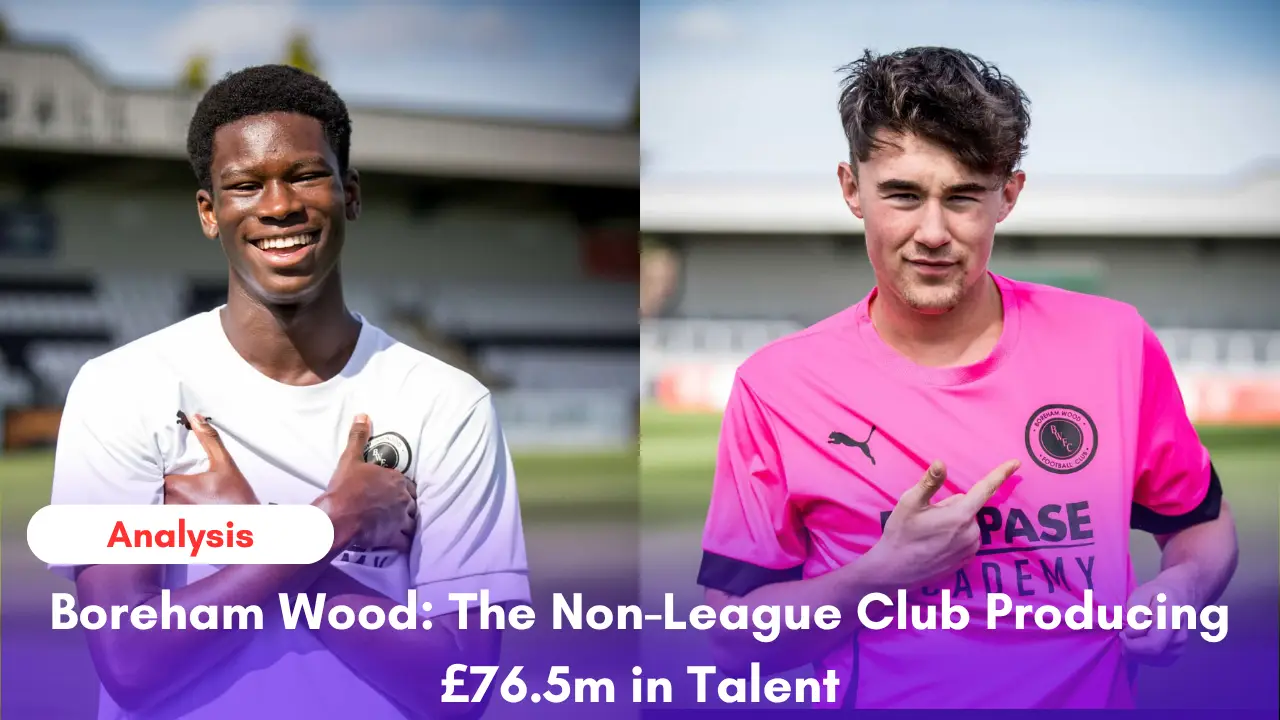
In the space of 48 hours last month, Boreham Wood sold three academy graduates for a combined £76.5m. Iliman Ndiaye went to Manchester City. Sorba Thomas went to Hull City. Abdul Abdulmalik went to Swedish side Djurgardens IF for £1.5m — the most expensive sale of a non-League footballer since Jamie Vardy left Fleetwood Town for Leicester City in 2012, a deal that changed how the entire pyramid thinks about where talent can come from.
“There’s real talent in the non-League. I see that ability on a regular basis.” — Luke Garrard, Boreham Wood manager
Garrard has been at the club for 11 years. He didn’t discover Ndiaye, Thomas and Abdulmalik by accident, and he’s not interested in pretending he did.
A pipeline, not a fluke
Neither Ndiaye nor Thomas arrived at Manchester City or Hull City in a straight line from Meadow Park. Ndiaye’s route ran through Sheffield United, Marseille and Everton. Thomas played for Huddersfield Town, Blackburn Rovers and Stoke City before Hull came calling. Boreham Wood doesn’t see a penny of the fees those clubs eventually commanded — academy-produced players carry no resale obligation back to the club that trained them once they’ve moved on and moved again.
Garrard is unsentimental about it. “If I were to flip it around, the fact of the matter is if you’re working for Manchester City, you’re probably thinking how many of their former clubs should we give a handout to, and where does it stop?” It’s a fair question, and it’s one the game has never really answered. Solidarity payments exist for a reason, but they don’t come close to reflecting the developmental debt a Premier League squad owes to a place like Meadow Park.
That’s not where Garrard’s pride sits anyway. “He loves the fact that Sorba and Iliman will never have to work another day in their lives after their football careers,” he says of chairman Danny Hunter. “That’s the romance for the chairman and myself.”
The mechanics behind the romance are less mystical than the sentiment suggests. Boreham Wood built a sports and education programme from the early 2000s, positioned in a catchment that pulls in prospects from across London — east, north, south and west. Ndiaye and Thomas both came through that system, developing under academy manager Cameron Mawer in a U18 side Garrard still calls “wonderfully successful.” Ben Goodliffe, sold to Wolverhampton Wanderers in 2017, came from the same production line.
Abdulmalik’s path was different, and it says something else about how Boreham Wood operates. Sporting director Charlie Hunter identified him as a target in the development leagues and Premier League Two, signed from Millwall after a loan spell at Wealdstone. Four or five clubs had already looked at him and decided he wasn’t right — a judgment call that now looks like one of the more expensive misreads in recent non-League history. Abdulmalik scored 17 goals and provided 10 assists in a breakout 2025/26 season, including in Boreham Wood’s play-off final defeat at Wembley, and was named the National League’s Young Player of the Season before Djurgardens moved.
“It was a sliding-doors moment for him at that point in his career. We benefited because Charlie Hunter was desperate for us to get him.” — Luke Garrard
The conviction that came early
Garrard isn’t retrofitting the story after the fact. He points to a quote of his own from the 2018-19 season, on record at the time, calling Ndiaye “a pet project who would get to the very top.” What he saw in a 16-year-old was an ability to unbalance seasoned professionals with no fallback plan if it didn’t work — no plan B, as Garrard puts it, because there was never meant to be a need for one.
Thomas announced himself differently. As an under-18, he stood beside Garrard watching the first team train and told him he’d be out there within a month. Garrard’s first instinct was that it sounded flash. His second instinct — the one that stuck — was respect for the conviction behind it. Thomas backed the statement up.
Both stories point at the same underlying mechanism: Boreham Wood isn’t just coaching technique, it’s identifying players with the temperament to survive being fast-tracked. That’s a harder thing to teach than a first touch, and it’s the part of the model that’s easiest for outsiders to miss when they reduce this to “a good academy.”
What this actually proves about the pyramid
Boreham Wood’s average home attendance is 1,200. That number sitting next to £76.5m is the whole story in miniature — a reminder of how disconnected football’s financial rewards are from where the actual development work happens. Garrard is diplomatic about it in public, careful to note he’d welcome elite clubs voluntarily rewarding the grassroots sides that shaped their newest signings. Boreham Wood got what he calls “a little tickle” once, enough to help pay for a kit order. That’s the extent of the formal gratitude the pyramid currently allows for.
“People thought there would never be another Jamie Vardy. Now I can say to our players, ‘Who wants to be the next Iliman, Sorba or Abdul?'” — Luke Garrard
What Boreham Wood has instead of a financial windfall is proof of concept, and in recruitment terms that’s arguably worth more. Two academy products have played World Cup football. A third became the most expensive non-League sale in over a decade. Garrard’s pitch to the next 16-year-old walking through the door at Meadow Park isn’t hypothetical anymore — it’s Ndiaye’s name, Thomas’s name, Abdulmalik’s name, and a specific route mapped out in front of them rather than a vague promise.
The December reunion
There’s a smaller story sitting inside the bigger one. Ndiaye and Thomas — academy team-mates, both shaped by Mawer’s under-18 side — will face each other in December when Manchester City play Hull City. Garrard has already said he hopes he’s free that day so he can watch, and that he’ll wear a half-and-half scarf and tell his kids, watching Match of the Day that night, that he coached both of them.
It’s a small, specific, almost domestic detail sitting underneath a story about £76.5m in transfer fees, and it’s the part that actually explains why Garrard keeps doing this. Not the fee. The scarf.
Boreham Wood’s academy sales at a glance
| Player | Sold to | Fee / notes |
|---|---|---|
| Iliman Ndiaye | Manchester City (via Sheffield United, Marseille, Everton) | Part of combined £75m Ndiaye/Thomas deals |
| Sorba Thomas | Hull City (via Huddersfield, Blackburn, Stoke) | Part of combined £75m Ndiaye/Thomas deals |
| Abdul Abdulmalik | Djurgardens IF | £1.5m — record non-League fee since Vardy (2012) |
| Ben Goodliffe (2017) | Wolverhampton Wanderers | [RESEARCH GAP — fee not disclosed in available sources] |
Combined Ndiaye/Thomas fee reported as £75m; individual breakdown not disclosed in available reporting.
FAQ
How much did Iliman Ndiaye and Sorba Thomas transfer for? Manchester City and Hull City completed the signings of Ndiaye and Thomas for a combined £75m within a 48-hour window, though the individual fee split between the two deals has not been separately disclosed.
What is the most expensive non-League transfer fee ever paid? Djurgardens IF’s £1.5m deal for Abdul Abdulmalik is the most expensive sale of a non-League footballer since Jamie Vardy’s £1m move from Fleetwood Town to Leicester City in 2012.
Where did Iliman Ndiaye come through the academy system? Ndiaye developed through Boreham Wood’s BW PASE Academy under academy manager Cameron Mawer before eventually reaching the Premier League via Sheffield United, Marseille and Everton.
Does Boreham Wood get money when its academy players are resold? No formal obligation exists — Boreham Wood does not receive a cut of fees generated by later transfers once a player has left the club, beyond any solidarity mechanisms already built into the transfer system.
Also Read: