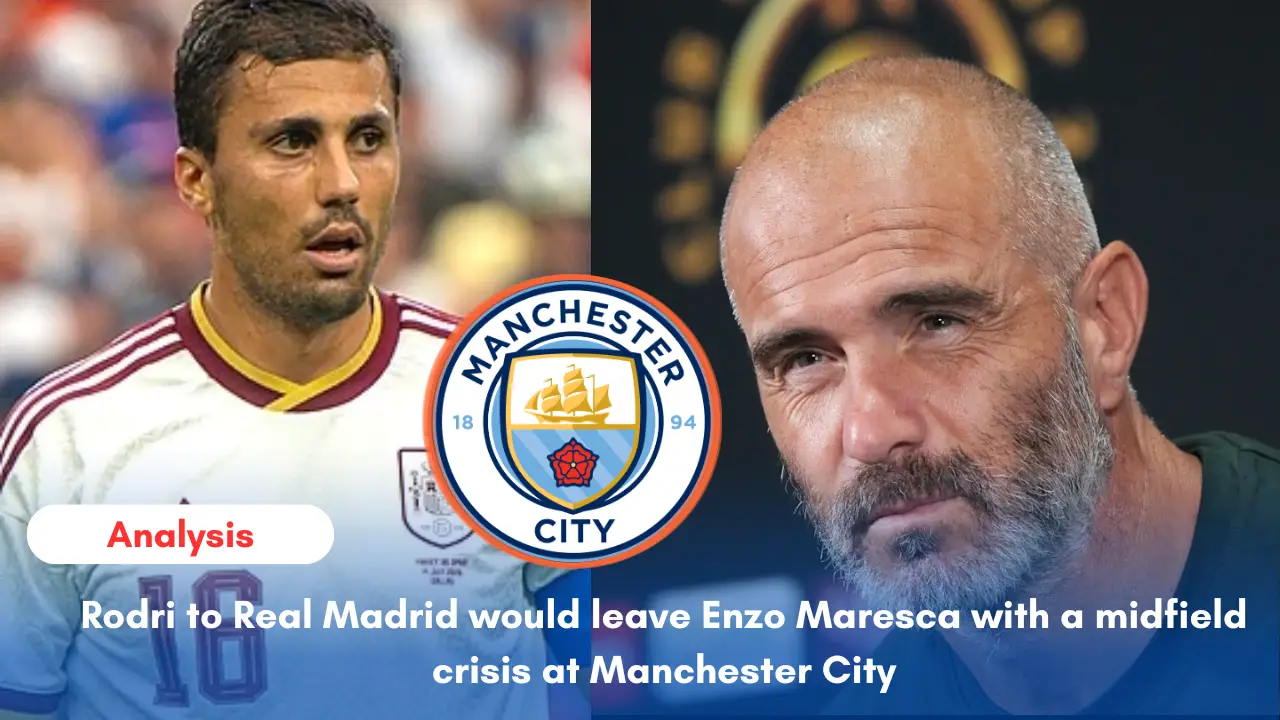
Manchester City are already navigating the most significant transition in more than a decade. Pep Guardiola has left, several senior figures have departed, and Enzo Maresca is only beginning to put his imprint on the squad. The possible sale of Rodri to Real Madrid would turn that difficult transition into a full-blown midfield crisis.
Real Madrid are confident of completing a deal for the Spain international before the 1 September transfer deadline. The 30-year-old is entering the final year of his contract and has made little secret of his desire to return to Spain. “Would I like to play in Spain again, in La Liga, in Madrid? I would like to return, yes, obviously,” he said earlier this year. Asked specifically about Real Madrid, he added: “You can’t turn down one of the world’s best clubs.”
Rodri’s performances at the 2026 World Cup have only strengthened Madrid’s resolve. After a difficult period disrupted by an ACL injury and subsequent setbacks, he rediscovered his best form on the biggest stage, dictating play from the base of midfield as Spain claimed the title. Guardiola had predicted as much last autumn. City now face the prospect of losing that version of Rodri just as they need continuity most.
Maresca has publicly downplayed the speculation. “Around big players there are always speculations so I am not worried about that,” the new manager said. “I think every manager wants to have Rodri because he is a top player.” Privately, the scale of the problem will be clear. Rodri is not simply a high-level midfielder; he has been the structural pivot of City’s midfield for years, capable of controlling tempo, breaking up play and progressing the ball in equal measure.
The current options behind him offer limited reassurance. Nico González, signed partly as cover during Rodri’s injury absence, failed to establish himself last season. Tijjani Reijnders showed early promise after arriving from Milan but faded as the campaign progressed. Mateo Kovacic, Rico Lewis and Kalvin Phillips are all understood to be available for transfer. Remove Rodri from the equation and the midfield depth looks thin for a club with City’s ambitions.
Elliot Anderson, signed from Nottingham Forest for £116 million, represents the most credible internal solution. The England international excelled as a ball-winning and progressive midfielder last season and matched Rodri for tackles at the World Cup. He has the profile to play as a single pivot, yet asking a 23-year-old to immediately replace a Ballon d’Or winner and World Cup-winning captain is a significant demand. City may also accelerate their interest in Lille’s Ayyoub Bouaddi, the standout young midfielder from Morocco’s World Cup run, if Rodri’s departure becomes imminent.
The wider context makes the situation more delicate. Bernardo Silva and John Stones have already left on free transfers. Guardiola’s exit has removed the central figure who shaped the club’s identity for eight years. Maresca inherits a squad in flux and a job that history suggests is extremely difficult. The post-Ferguson years at Manchester United and the post-Wenger period at Arsenal remain cautionary tales.
Retaining Rodri would provide a vital thread of continuity. Losing him would force Maresca to rebuild the midfield while simultaneously adapting the team to a new style of play. City’s hierarchy will be determined to avoid the prolonged instability that has afflicted other clubs after the departure of a transformational manager. The potential sale of their most important remaining midfielder would make that task considerably harder.
Maresca has spoken calmly about the need for time and the strength of the club’s structure. Those qualities will be tested if Real Madrid succeed in taking Rodri to the Bernabéu this summer.