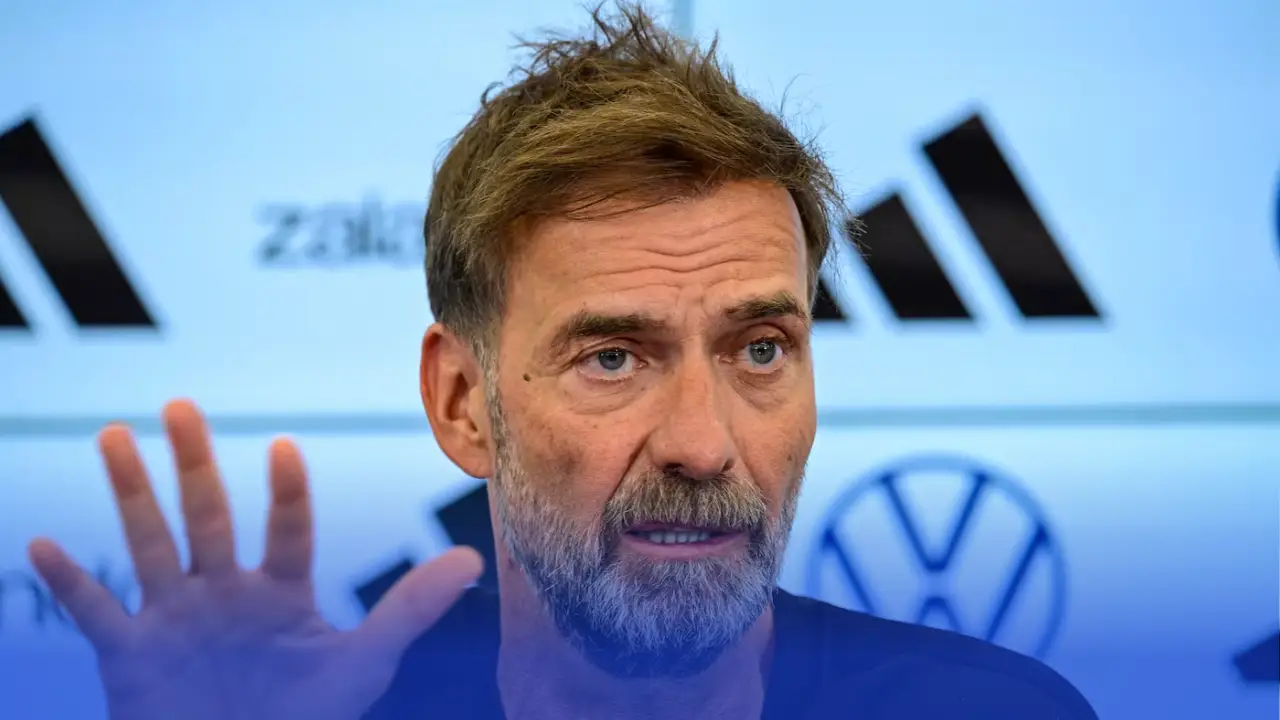
Jürgen Klopp has named his first Germany squads since taking charge of the national team, and the approach is characteristically bold. Instead of a single 23- or 26-man list, the former Liverpool and Borussia Dortmund manager has selected 44 players split into two distinct groups for the upcoming UEFA Nations League fixtures. The second of those groups will face Serbia at home and Greece away, and it is this list that offers a clear window into how Klopp intends to rebuild and refresh the national side.
The squad for the Serbia and Greece matches is as follows:
Goalkeepers:
Noah Atubolu (Eintracht Frankfurt), Finn Dahmen (Augsburg), Jonas Urbig (Bayern Munich)
Defenders:
Waldemar Anton (Borussia Dortmund), Ridle Baku (RB Leipzig), Finn Jeltsch (Stuttgart), Maximilian Mittelstadt (Stuttgart), David Raum (RB Leipzig), Malick Thiaw (Newcastle United)
Midfielders:
Mika Baur (Celtic), Tom Bischof (Bayern Munich), Vitaly Janelt (Brentford), Felix Keidel (Elversberg), Aleksandar Pavlovic (Bayern Munich)
Attackers:
Karim Adeyemi (Barcelona), Jonathan Burkardt (Eintracht Frankfurt), Nick Woltemade (Juventus), Said El Mala (Koln), Brajan Gruda (RB Leipzig), Florian Wirtz (Liverpool), Derry Scherhant (Freiburg)
This is not a traditional “B” team. Klopp has been careful to stress that there is no hierarchy between the two groups. Both contain a mixture of experienced internationals and players receiving their first senior call-ups. The decision to split the squad across four matches — Netherlands and Greece first, then Serbia and Greece again — reflects both the compressed nature of the international calendar and Klopp’s desire to assess as many players as possible in competitive conditions.
A New Coach, A New Approach
Klopp replaced Julian Nagelsmann after Germany’s early exit from the 2026 World Cup. The early departure marked the third consecutive major tournament in which the four-time world champions failed to progress deep into the knockout stages. The appointment of Klopp was widely viewed as a statement of intent: a return to intensity, clarity of identity, and a willingness to trust younger players while still demanding high standards.
By naming two large groups rather than one restricted squad, Klopp has effectively turned the September–October window into an extended audition. Players who perform well in the first two matches may force their way into consideration for the second set of fixtures, while those in the second group have a clear opportunity to impress without the pressure of being labelled reserves.
The Serbia and Greece fixtures themselves present different challenges. Serbia at home will demand control, technical quality and the ability to break down a side that can be organised and physical. Greece away is traditionally a difficult assignment — compact, disciplined and difficult to open up. Klopp will want to see how his players handle both scenarios.
Goalkeepers: Three Options, Clear Hierarchy in Development
Noah Atubolu, Finn Dahmen and Jonas Urbig form the goalkeeping contingent for these two matches. Atubolu has established himself as a consistent performer at Eintracht Frankfurt and continues to push for more regular international involvement. Dahmen brings experience and reliability, while Urbig’s inclusion from Bayern Munich underlines the pathway that still exists from the Bundesliga’s biggest clubs into the senior national team.
Klopp has not yet settled on a long-term number one, and these fixtures will provide useful minutes for all three. In the modern game, goalkeepers are expected to contribute more than shot-stopping; distribution under pressure and the ability to start attacks from the back are essential. All three players will be assessed against those criteria.
Defenders: Balance Between Experience and Youth
The defensive group is built around a core of players who already have significant senior experience mixed with younger options still establishing themselves.
Waldemar Anton and Malick Thiaw offer central defensive alternatives. Anton, now at Borussia Dortmund, brings physical presence and a strong understanding of positioning. Thiaw, operating in the Premier League with Newcastle United, adds recovery pace and experience of a different tactical environment. Their ability to play in a back three or a conventional back four gives Klopp flexibility.
At full-back and wing-back, David Raum and Ridle Baku provide attacking thrust from wide areas. Both are comfortable pushing high and delivering quality service into the box. Maximilian Mittelstadt and the younger Finn Jeltsch, both of Stuttgart, add further depth and competition. Jeltsch’s inclusion is particularly notable as a recognition of consistent club form rather than established international reputation.
The defensive unit as a whole looks equipped to handle both possession-dominant games and moments when Germany are required to defend deeper transitions.
Midfield: Control, Progression and New Faces
The midfield selection is one of the more intriguing parts of the list. Aleksandar Pavlovic and Tom Bischof represent the Bayern Munich production line — technically secure, progressive and already accustomed to high standards at club level. Pavlovic in particular has shown the ability to control tempo and break lines with his passing.
Vitaly Janelt brings Premier League experience and defensive midfield steel from his time at Brentford. His inclusion offers a different profile: a player comfortable screening the defence and winning the ball in central areas.
Mika Baur (Celtic) and Felix Keidel (Elversberg) are the more unexpected names. Baur’s development in Scotland has been closely monitored, while Keidel’s call-up from Elversberg continues a pattern under Klopp of rewarding strong performances regardless of the size of the club. These selections send a clear message that form, rather than reputation alone, will dictate opportunities.
Attackers: Creativity, Pace and Depth
The attacking group is headed by Florian Wirtz. The Liverpool midfielder-forward remains one of the most technically gifted players available to Germany. His ability to operate between the lines, create chances and finish from midfield makes him a central figure in almost any system Klopp deploys.
Karim Adeyemi offers direct pace and goal threat, whether from wide areas or more central positions. Jonathan Burkardt and Nick Woltemade provide different centre-forward profiles — one more mobile and link-oriented, the other a traditional presence in the box.
Brajan Gruda, Said El Mala and Derry Scherhant complete the list. All three are still at the stage of their careers where consistent international exposure can accelerate development. Gruda’s technical ability and El Mala’s goal-scoring record at club level have earned them this opportunity. Scherhant’s inclusion from Freiburg further underlines the breadth of the search.
What This Squad Represents
This second group is not simply a collection of understudies. It contains players who can start for Germany in the near future and others who are being given a genuine chance to force their way into the longer-term picture. Klopp’s willingness to look beyond the traditional hierarchy — selecting players from Celtic, Elversberg and other clubs outside the usual pathway — is deliberate.
The Nations League fixtures against Serbia and Greece will not define the entire Klopp era, but they will provide early evidence of the direction of travel. Intensity without the ball, clarity in possession, and the courage to trust younger players in important moments are likely to be recurring themes.
For the players involved, the message is straightforward. Perform well over these two matches and the door to the senior national team remains open. Struggle, and the competition for places will only intensify as more candidates are assessed.
Germany under Klopp is still in the early stages of construction. The squad named for Serbia and Greece is one piece of that process — a carefully chosen group designed to test ideas, evaluate individuals and begin the work of restoring the national team to consistent contention at major tournaments.
The coming matches will show how far that work has already progressed.