Manchester United have banned 685 season-ticket accounts after a summer-long investigation into ticket touting, with a further 464 supporters handed reduced sanctions or final warnings.
The club say the operation, launched in July, targeted organised networks that controlled, sold and distributed tickets from hundreds of accounts for financial gain. Of the cases reviewed, 468 were closed with no further action after fans provided satisfactory explanations. An independent appeals panel upheld 499 bans lasting one season; those affected can rejoin the waiting list afterwards. Seventy-three bans were not appealed and 113 followed repeated non-response to information requests.
United insist the exercise has placed more tickets in the hands of genuine supporters and that any seats sold on a match-by-match basis until the process concludes will be at season-ticket prices only. “The club is not profiting from this process,” they stated. Refunds have been or will be issued to banned holders.
Yet the numbers sit inside a much deeper fracture. Relations between Manchester United and their match-going support have reached a new low.
It is a little more than five weeks since Luca Black resigned as the under-21 representative on the Manchester United Fans’ Forum. He left after reaching the conclusion that the forum was being stripped of any real power by a club driving an ever-growing wedge between itself and supporters.
“I said to someone the other day that it’s like the parable of the boiling frog,” Black explained. “The frog sits there in the water as it heats up and doesn’t realise until it’s eventually at boiling point. That’s kind of how I felt by the end. You fought along the way but you also stayed there engaging with the club hoping it can maybe get better for supporters because they keep promising it will and that they will listen to us. But I just feel like commercialism is taking over completely now. The mistrust among fans has doubled, tripled, quadrupled.”
United fans have been at war with the Glazer family since before the Americans’ hostile takeover was pushed through in 2005. Any hopes that relations might improve once the Failsworth-born billionaire Sir Jim Ratcliffe took over the day-to-day running of the club two-and-a-half years ago have been detonated amid a perceived assault on the loyal, regular match-going support.
Black was one of a number of fan representatives who listened to Ratcliffe sell a vision for United on a Teams call after he acquired an influential minority stake from the Glazers. Many supporters now feel the approach the Ineos founder has taken to cutting staff jobs and costs has been mirrored by a series of deeply unpopular measures that have hit legacy fans hard. They see these steps as part of gradual efforts to push them out in favour of bigger-spending tourists and day-trippers.
There were protests after a flat-rate £66 ticket for members with no concessions was introduced mid-season with no prior consultation in 2024. Older supporters accused the club of trying to price them out after a 50 per cent discount was halved to an across-the-board 25 per cent rate. There was further anger when fans in the lower south stand, many of whom had sat in the same seats for years, were relocated to make way for so-called “VVIP hospitality” — a move the club said was necessary to help keep season-ticket price increases to a minimum.
But it is the club’s management of a heavy-handed anti-ticket-touting crackdown that appears to have pushed an already tense relationship to breaking point.
685 season tickets gone. 464 more restricted. Trust among lifelong fans has collapsed further.
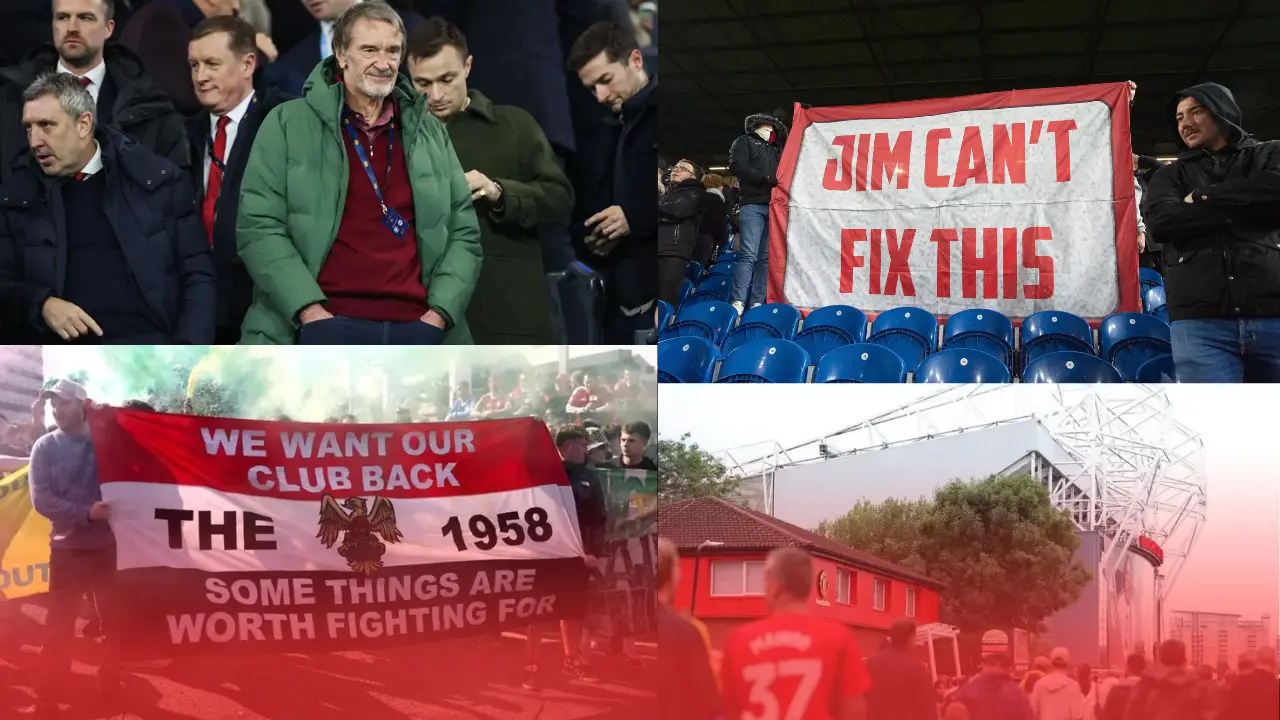
Before Sunday’s Manchester derby, the demonstrations that began outside the Bishop Blaize pub on Chester Road 90 minutes before kick-off wound their way round to the corner of Sir Matt Busby Way amid plumes of red, green and gold smoke. A stone’s throw from where battle-worn season-ticket holders took aim at the Glazers and Ratcliffe for, in their words, “treating us like s—”, a couple of touts were busy flogging tickets to day-trippers and fans from overseas for €250 (£220) apiece.
“You want to tackle real touts? Open your front door on match day,” Steve Crompton, of the 1958 fans’ group that is behind the protests, told reporters. “Come out and deal with it. One of the things that has upset so many United supporters about this whole process is there are loyal fans who feel they’ve been cast alongside the organised touts and vilified from the outset.”
United insist the operation has broken up large-scale organised networks of touts and will see more tickets placed in the hands of genuine fans at a time when demand far outstrips supply. They refute any notion of innocent fans being unfairly punished. They also say some of the sob stories that have gained traction on social media are untrue and that, contrary to claims, evidence has been presented to affected fans over why their accounts were red-flagged.
Plenty of supporters see it very differently. They are appalled both by the way the process has been communicated and conducted and by the disproportionate damage it has done to already eroding trust for what they consider relatively little gain.
Many fans were shocked to receive what they considered aggressively worded emails out of the blue asking them to prove they were not touting. There has been particular anger over the upset and distress caused in the 468 cases where fans were fully absolved after satisfactorily explaining their account activity, and over concerns that the club launched the process without first fully understanding the extent to which supporters shared log-ins in circumstances they regarded as legitimate.
Sanctioned ticket holders have the opportunity to refer their case to the Independent Football Ombudsman. But there are fears there will not be enough time for a thorough review of their cases before United start reallocating season tickets after the international break.
Fan groups have indicated they are watching closely to ensure the resale of tickets on a match-by-match basis is done at season-ticket prices amid the club’s insistence they are not profiting from the process.
“Too often the most loyal, travelled fan is targeted with poor communication and patronising, threatening attitudes, as if we are a nuisance,” Barney Chilton, editor of the Red News fanzine, said. “We all want touting eradicated but it’s a bit ironic to use a hammer to crack nuts when many of the Premier League clubs are over-inflating prices and all but touting themselves. This has long been coming, but for the legacy fans it feels like the beginning of the end.”
Loyal fans feel cast alongside organised touts. The atmosphere at Old Trafford is already paying the price.
The response to the ticket-touting row was notable because it drew unified condemnation from across a fanbase that has often appeared quite splintered. “If Jim Ratcliffe has done one thing that’s good for this football club it’s to unify the fanbase against him,” Crompton said.
Black’s final meeting of the Fans’ Forum took place at the Heritage Club, one of Old Trafford’s premium hospitality suites, on 30 July and was attended by Omar Berrada, the United chief executive. Discussion of the ticket-touting operation dominated the agenda for more than an hour. The tension in the air was palpable. “It was a lot more heated than usual,” Black said. “It got quite fiery.” At one point a club official and a fan representative had to be encouraged to stop shouting at each other.
During his tenure as chief executive, Richard Arnold had worked hard to rebuild trust with supporters in the wake of the European Super League debacle that, for a fanbase long in rebellion against the Glazers, proved the straw that broke the camel’s back. United’s game against Liverpool in May 2021 was postponed after fans stormed Old Trafford in furious protest. Whatever goodwill had been built up appears to have all but disappeared now.
Black believes the substantive power that used to sit with the Fans’ Forum has moved to an extent to the Fan Advisory Board, which Berrada co-chairs, that has no minuted meetings and where involved parties are bound by non-disclosure agreements. Confidentiality is understandable to an extent given financially sensitive information is sometimes discussed. “But I said in my resignation letter I felt we’d reached the point where that requirement was being used as cover to withhold far more than it needs to and I stand by that,” Black said.
The Premier League is now into its 35th season and coming off the back of a summer in which its 20 clubs — 16 of which are owned or controlled by foreign investors — spent a record £3.49bn on players. In the thirst for ever more cash to stay relevant and competitive in the world’s richest football league, many supporters feel historic clubs are being ripped away from their community roots and working-class culture amid an increasingly rampant, US-led model of commercialisation that prioritises corporate customers over loyal regulars.
United fans are not alone. Supporters at many of their biggest rivals have similar stories. Whereas United have no control of the broadcast deals, are not guaranteed Champions League qualification and its myriad riches every season, and have to work hard to attract sponsors, match-day income is one lever they do have considerable sway over.
Stephen “Melgie” Merry has been following United home and away since 1968. He calculates that he has travelled more than 500,000 miles watching the team around the world. When he speaks, his voice is laced less with anger than a profound sadness at the huge disconnect he feels now exists between the club and its match-going fans.
“They don’t care about us, that’s how I feel,” Merry said, straining to be heard above the din of anti-Glazer and Ratcliffe rhetoric during Sunday’s protests. “We are its heart and soul and, without us, football is nothing. But I honestly believe they don’t want us, despite what they say.”
Matt Finlay, from Worsley, who has been a season-ticket holder for 18 years, echoes those sentiments. “There’s the underlying feeling that standard season-ticket holders are less valuable,” he said. “Apart from the occasional beer at half-time, I don’t add much to my £800 season ticket whereas day-trippers do as they pay more for a ticket and are also infinitely more likely to spend in the club shop. The standard match-going fan is acutely aware of this but you take them away, replace them with the equivalent numbers of day-trippers and the atmosphere dies.”
Which cuts to the heart of an issue that is much harder to quantify on a balance sheet: how costly in the longer term is a potentially poorer atmosphere both to a team’s success and, in turn, the club’s revenue base?
It felt telling on Sunday when the 10 men of City controversially went ahead on the hour mark that there was not the huge rallying in the stands United’s players needed. In the Stretford End, the usual flags had been removed before kick-off and replaced with a single banner that read: “The Way You Treat Us Is A Disgrace.” If hardcore supporters feel unwanted and unloved, that is a slippery slope.
“The psychology is important here because if a fan feels he is valued and part of the club that’s very different to feeling like you’re little more than a customer there to be exploited,” one season-ticket holder, who asked not to be named, explained. “And the thing a customer does if he feels the product they’re getting is substandard is complain. It’s the unconditional support that encourages players in part to take risks and be creative and if you haven’t got that or you erode that, it’s very damaging.”
Steve Hayward-Jones is on the Manchester United Supporters Trust committee and runs the Cheeses of Nazareth X account that has been assisting genuine fans caught up in the ticket-touting furore. Amid lingering anger over the row, he said the atmosphere at Old Trafford felt flat during the 5-2 win over Ipswich in the first home game of the season.
“When a five-goal home win feels subdued, you know the disconnect between the club and the supporters has cut deep,” he said.
Without the regulars who travel and sing, the product the commercial model sells loses its edge.
Sanctioned fans can still refer cases to the Independent Football Ombudsman. The club says it will wait until after the international break before reallocating seats. Whether that process restores any of the trust already spent remains the next test.
Author Byline
By Luca Ferrario | Sports Writer, Sportspherearena
Sports journalist covering football and tennis across major leagues, Grand Slams, ATP Masters, WTA 1000 and global competitions.
Also Read : Bristol City vs Lincoln City: Prediction, Lineups & Kick-Off Time — Championship
Genoa vs Südtirol: Prediction, Lineups & Kick-Off Time — Coppa Italia