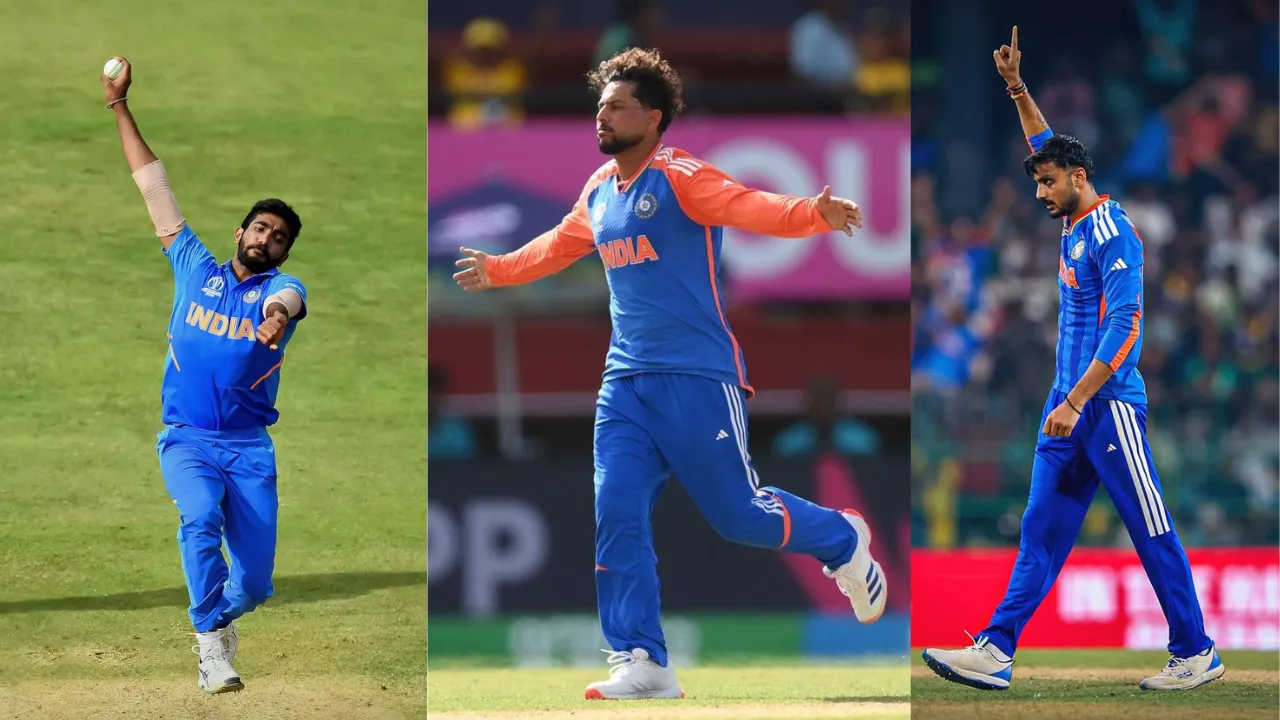
The Attack Built Around One Man
Jasprit Bumrah fielded a routine ball at Cardiff on July 16. His left knee swelled through the night. By Sunday morning, India were walking out to a series decider at Lord’s without him.
The outcome was not a surprise. England posted 387 for 3. Without Bumrah, India’s bowling reduced to Axar Patel — who went wicketless across ten overs — and three seamers who gave up 221 runs between them. Gurnoor Brar, a 26-year-old still finding his feet at this level, conceded 97 from ten overs without a wicket, the third most expensive spell in Indian ODI history according to ESPNcricinfo. India lost by 27 runs. 2-1 to England.
But the scoreline is only the surface. What Lord’s revealed was a structural problem that has been building for years — one no scorecard can fully capture, and one that no amount of talk about succession is going to solve.
When Bumrah took the field at Edgbaston in the first ODI, it was his first appearance in the format in 968 days — since India’s defeat to Australia in the 2023 World Cup final in Ahmedabad, as confirmed by ESPNcricinfo. India managed his return carefully across two matches. He was meticulous: contained, authoritative, exactly what a spearhead should be. Then his knee swelled, and all of it disappeared with him.
India have known this problem was coming. The question of what happens when Bumrah is unavailable has followed this team through World Cups and overseas tours with the same unanswered persistence. Lord’s provided the answer again: 387 on a flat pitch on a Sunday afternoon, with four seamers and a finger-spinner playing defensive cricket in the middle overs.
Captain Shubman Gill was candid afterwards. “If you look at the first squad that we announced, at least five of the players did not play today,” he told reporters after the match. “When one player gets injured, you have to play a different combination. If two are injured, you play a different combination. I think if a player is missing after every match, somewhere we are missing a trick.”
He added the line that frames the 2027 problem most clearly: “Keeping the World Cup in mind, we have to play eleven matches in a row. And here the players are unable to finish a series of two or three matches.”
Eleven matches in a row. In South Africa. Without any guarantee that Bumrah stays fit for all eleven. That is the tournament India have to prepare a bowling attack for. Lord’s showed that preparation has not started.
The Question Nobody Will Answer
Kuldeep Yadav did not bowl a single ball in England. Not in the T20Is. Not across three ODIs. He was in the squad. He was fit. He made the trip. He did not play.
ESPNcricinfo’s Sidharth Monga, writing after the Lord’s defeat, noted that Kuldeep has taken more ODI wickets than any spinner in the world since his debut in June 2017 — more than Adil Rashid and more than Adam Zampa, at a better average and economy than both. He has 194 wickets in 121 ODIs. He has two ODI hat-tricks to his name — the only Indian to take two — and was India’s leading wicket-taker in the 2023 World Cup cycle, picking up 49 wickets at an average of 20.4.
Gill explained at the post-match press conference that India did not consider Kuldeep for the third ODI because the surfaces in Birmingham and Cardiff had not favoured spinners in the first two games, and the team wanted to attack the middle overs with an extra seamer. Kuldeep was the lone wristspinner in the squad and did not feature in a single match across either format of the tour.
The logic applied to the first two ODIs, where spinners were asked to contain rather than attack, has some basis. Applied to Lord’s — where Axar went wicketless across ten overs, where the pitch offered little to the fast bowlers, and where India ultimately conceded 387 — it becomes something harder to explain.
Monga made the point directly in ESPNcricinfo: “Even when pushed to the wall and forced to play four tailenders in an ODI XI, India found a way to leave out Kuldeep at Lord’s which is a matter of significant concern.”
Former India captain Mohammad Azharuddin had been making the same argument about the Test leg of the same tour weeks earlier. Speaking to PTI, he said: “They are too much dependent on Bumrah. It’s not easy because you need more experienced bowlers, and they should play Kuldeep Yadav.” He was talking about the Tests. The point applied with equal force to the ODIs.
ESPNcricinfo’s analysis of the selection pattern was direct: “In 2025 and 2026, Kuldeep has travelled all over England for two of the three formats of a staggered tour without getting a single game — and a single allrounder in sight who can make those claims. The players he has been losing out to have nailed down neither a bowling spot nor a batting spot.”
That is the contradiction at the centre of this policy. Kuldeep is excluded because India need batting depth from their lower order. But the all-rounders replacing him are not delivering that batting depth reliably either, which means the team is trading away its best spinning wicket-taker for partial contributors in both roles. The rationale defeats itself in practice.
Jadeja: The Silence Is the Problem
Ravindra Jadeja was left out of the Afghanistan series. He was left out of the England series. On both occasions, the selectors said he remained part of their World Cup plans.
Chief selector Ajit Agarkar, explaining Jadeja’s absence from the Afghanistan ODIs in May, told reporters: “With regard to one-day cricket, we have 15-16 months left to that World Cup. Somewhere around there, we want to obviously try and assess what our options are, particularly keeping in mind the conditions in South Africa and give a little bit of exposure to some of the newer guys. We know what Ravindra Jadeja or Axar Patel can do.”
As a statement of intent, that is reasonable. As a plan, it is not. Because Jadeja stays out. The players trialled in his place come and go — Harsh Dubey arrived at Lord’s as injury cover for Washington Sundar and bowled zero balls; Shivam Dube played two ODIs and was dropped for the decider for tactical reasons — and no threshold is stated for what any of them need to achieve before the World Cup squad is named.
There is a credible case for moving on from Jadeja in the 50-over format. South African conditions favour pace over left-arm finger spin. Axar Patel’s performance in the first ODI at Edgbaston — four wickets and an unbeaten half-century — gave the selectors exactly the kind of dual contribution the role requires. The transition, if that is what is happening, is defensible.
But it needs to be said. Clearly. Not implied through serial omission while describing the absent player as still part of the plans. Nearly 3,000 ODI runs and 232 wickets across his career earn Jadeja the clarity of a direct decision — not a policy of strategic silence.
Sixteen Months Is Not Very Long
The World Cup in South Africa starts in October 2027. Sixteen months from Lord’s. Eleven matches to win it.
India’s bowling attack at Lord’s without Bumrah: Axar Patel (0/65 from 10 overs), Arshdeep Singh, Gurnoor Brar (0/97 from 10 overs), Prasidh Krishna (2/69 from 10 overs), Prince Yadav. Kuldeep Yadav sat in the dugout with 194 ODI wickets.
As ESPNcricinfo noted after the match, the all-rounders India are building this attack around have not yet nailed down either role convincingly enough to justify the trade-off being made. That observation was about Kuldeep. It applies equally to the whole construction.
Fourteen months from now, India will need to beat Australia, England and Pakistan on tracks where the new ball moves and the old ball skids on. The bowling attack required for that tournament does not currently exist in functional form without Bumrah. Gill knows it — he said so from the Lord’s press conference. Agarkar knows it — he acknowledged the fast bowling depth question publicly back in 2022. The question now is whether sixteen months is enough time to actually build something, or whether the team arrives in Johannesburg having spent the window talking about options without making decisions.
Kuldeep Yadav is 31 years old. He is sitting on 194 wickets and a flight back to Delhi. Nobody has told him why.