SUBHEADLINE:
The world No.2 vanished from social media within minutes of her Queen’s Club defeat. It is the most visible sign yet of a gambling-fuelled abuse problem that is reshaping how female tennis players live their lives online.
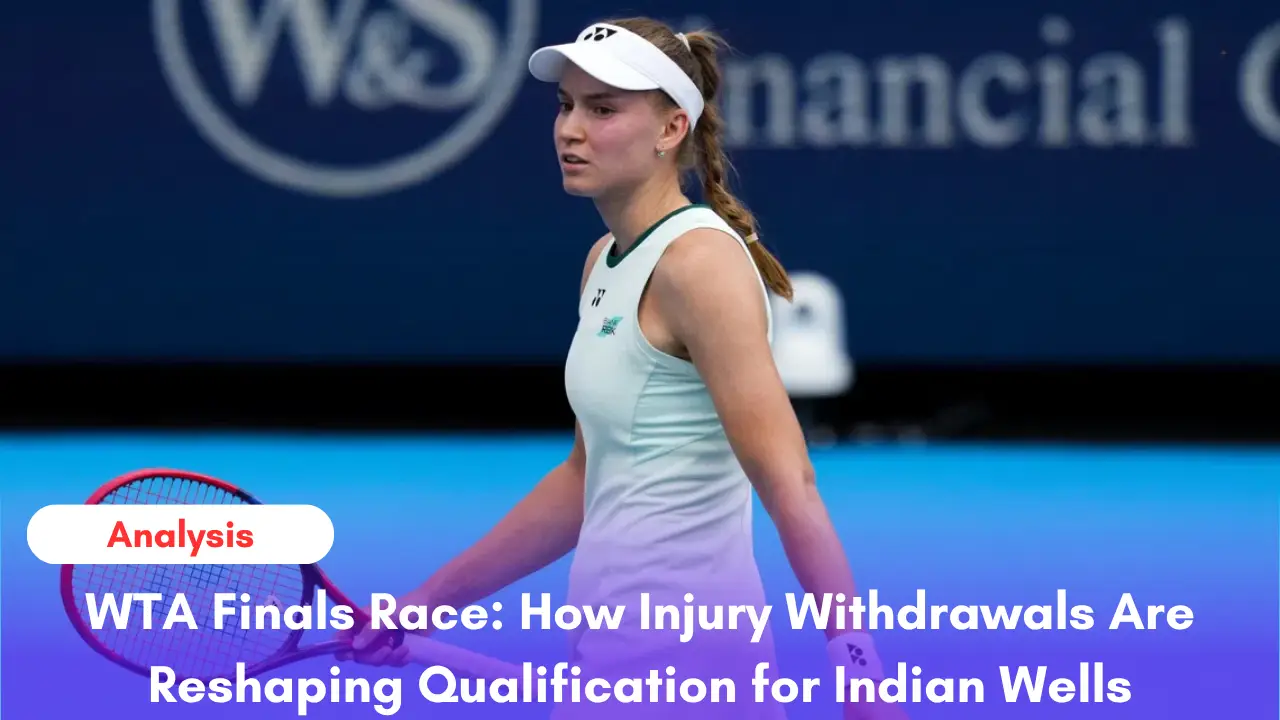
Elena Rybakina walked off the Andy Murray Arena on Friday having just endured one of the most gruelling days of her season. Two matches, nearly five hours of tennis across a rain-disrupted schedule at the 2026 Queen’s Club Championships, and ultimately a 7-5, 2-6, 6-4 defeat to British wildcard Katie Boulter in the quarter-finals. By the time she reached the locker room, her Instagram account was gone.
The world No.2 deactivated her profile within minutes of the final point — a move that immediately unsettled the tennis community, and one that almost everyone understood without explanation.
It was not her first signal. Weeks earlier, following her second-round exit at Roland Garros, Rybakina had quietly disabled comments on her posts. Friday’s step was more decisive. The account disappeared entirely, with no statement and no official reason given.
Gambling abuse in tennis: a pattern that keeps repeating
Rybakina’s social media exit follows a pattern that has become grimly familiar in women’s tennis. After her surprising second-round loss at the French Open, she disabled comments on her posts — and after the Queen’s Club defeat, she deactivated her account entirely.
When a highly-ranked player loses — particularly in an upset — her accounts are flooded within seconds by abuse from gamblers who lost money on the result. The messages range from insults to explicit threats. The volume is immediate and often overwhelming.
The bitter irony is that Katie Boulter — who recorded the biggest win of her career by beating Rybakina on Friday — knows this cycle just as well as her defeated opponent. Boulter has spoken openly about death threats and abuse she receives on social media: “It becomes more apparent every single time you go on your phone. I think it increases in number and also increases in the level of things that people say. I don’t think there’s anything off the cards now.”
Amanda Anisimova faced a similar torrent this week after losing her semi-final to 18-year-old Iva Jovic.
The WTA online abuse report: what the numbers reveal
This is not anecdote. In June 2025, the WTA and ITF published the sport’s first-ever season-wide online abuse report — and the data was stark.
The Signify Group’s AI-powered Threat Matrix service analysed 1.6 million posts and comments throughout 2024, verifying around 8,000 as abusive, violent, or threatening — originating from 4,200 accounts. Of those, 97 prolific users were responsible for nearly a quarter of all harmful messages.
Five WTA players alone received more than 26% of all verified abuse, while 97 accounts were responsible for 23% of all abusive messages sent to over 450 targeted players. Tennis.com
The gambling link was direct and measurable. Angry gamblers made up the vast majority of direct abuse at 77% — at a higher level compared to open-source social media at 40% — as abusers seek to cause direct emotional distress to players following lost bets.
Jessica Pegula, a member of the WTA Players’ Council, was clear: “Online abuse is unacceptable, and something that no player should have to endure. It’s time for the gambling industry and social media companies to tackle the problem at its source and act to protect everyone facing these threats.”
What tennis is doing — and where the gaps remain
The WTA and ITF have not been passive. The Threat Matrix service launched in January 2024, protecting players and tennis family members from targeted online hate and threatening direct communication. The service is now being enhanced to include real-time social media moderation, automatically hiding or removing harmful content across major platforms.
But Rybakina’s decision this week exposes the limits of reactive tools. No monitoring system prevents the first wave of abuse that arrives the moment a match ends. For a player who had already quietly withdrawn after Roland Garros, Queen’s Club was apparently the breaking point. Switching off an account is a player protecting her own wellbeing when external protections fall short.
Tennis is uniquely exposed among major professional sports. Its individual format makes every loss personal and every result traceable to one athlete. A vast and growing global betting market amplifies that vulnerability. When a favourite falls, a significant number of bettors respond by directing their anger directly at her.
Almost every day of the ATP and WTA season, players share screenshots on social media of the hate they receive from disgruntled gamblers. It has become an all-too-common occurrence, especially for lower-ranked players who already face long odds of winning tournaments.
Wimbledon 2026 is two weeks away
Rybakina arrives at Wimbledon — which begins June 29 — as one of the grass-court title favourites, and without an Instagram presence. The conversation her disappearance has started, however, is more consequential than her seeding.
When a player of her standing feels compelled to remove herself from public life to avoid abuse after a tennis match, it is a measure of how much ground the sport still has to cover. The WTA and ITF have acted. Players have spoken. Social media platforms have been called upon to step up. The gambling industry — whose customers sit at the centre of this crisis — has largely not.
Wimbledon is the sport’s most-watched stage. It is also the right moment to demand a more urgent answer to a question that has gone unanswered for too long: how much more will it take?